
I believe it’s been far too long since I updated the site with information on the projects I have been working on. Recently, I’ve taken to discussing my passion for gaming and the media that has influenced it.
While fun, I found the journey to be arduous and a lot harder than I first imagined, but also incredibly rewarding. Below, I wanted to lay out the ground rules for the game Heroic Arc and go over its core concepts. All while keeping its development and design process transparent and open to feedback.
My end goal is to have a system that can be played in the library or community, with a simple yet elegant set of rules for standard play. Unique cards and commissioned art to reward investment in the program… all while giving gamers a chance to try out something unique.
Below are a few concept ideas, but as things progress, I plan to share much more!
The character sheet was an attempt to have a system in place before dedicated skill cards were introduced. Using a sheet with skills listed, players would assign each skill a number and use a standard deck of playing cards to simulate the flow of play. In hindsight, I should have gone with this initial plan to have a working prototype, but I realized I’m very much a perfectionist when it comes to presentation, so I decided against it.
The clash system was simpler then and prevented all actions, but in trials I found separating it to specific actions really added to the strategy.

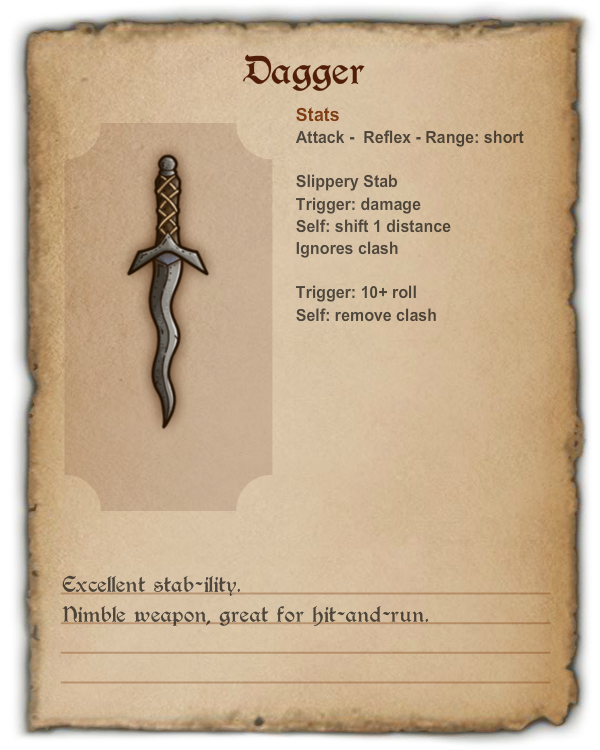
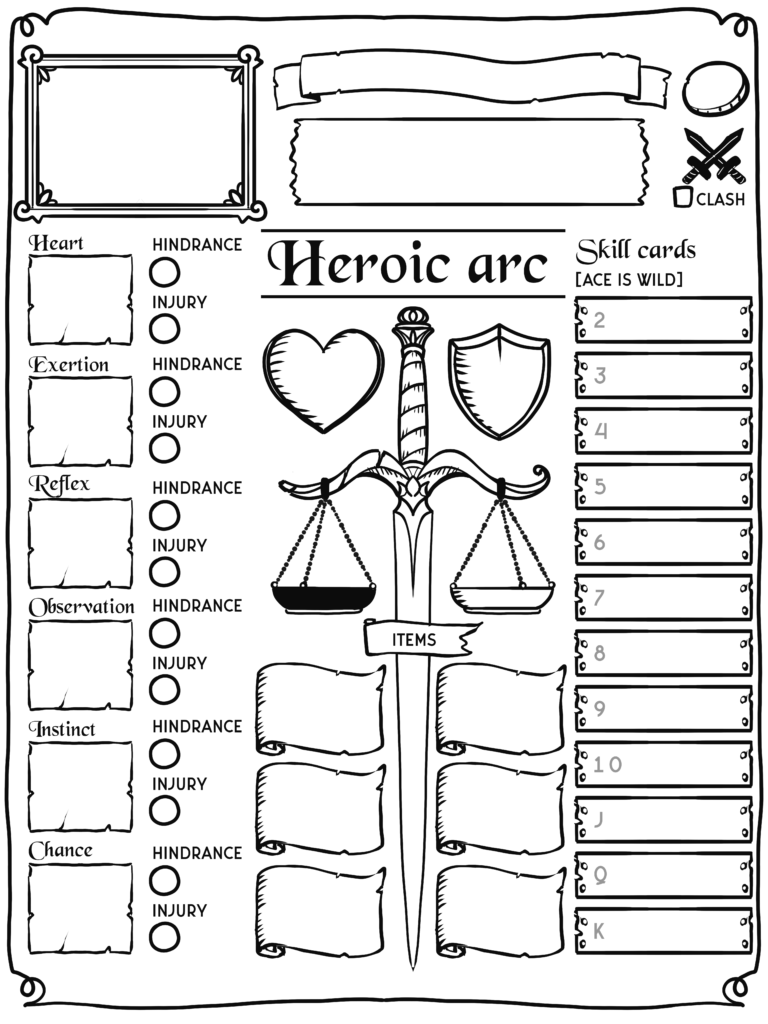
Anyways, before I keep discussing too much, I want to present the first draft of the Playtest Materials – Minus skill/item cards. To explain the core concepts of the game itself and the design philosophy behind it.
HEROIC ARC (First Draft)
Overview
HEROIC ARC is a cooperative storytelling game where players take on the role of heroic adventurers completing quests, battling monsters, and shaping the story through their actions.
The game blends tabletop roleplaying with card-based abilities, creating a fast, cinematic experience where players control the flow of the scene like a movie camera following the action.
Core Rolls & Attributes
Each hero has 6 attributes:
- Health – resilience, endurance
- Exertion – strength, physical power
- Reflex – speed, agility
- Observation – awareness, logic
- Instinct – improvisation, reaction
- Chance – luck, narrative influence
At character creation:
- Set one attribute to +2
- Set another to +1
- All others remain +0
Rolling
Most actions are resolved with:
2d6 + relevant attribute
Results:
- 6 or less (Fail) → You fail and lose scene control
- 7–9 (Partial Success) → You succeed with a complication; control shifts
- 10+ (Success) → You succeed cleanly and retain control
These outcomes ensure the story always moves forward.
Scene Control & Initiative
At the start of combat:
- Each side rolls 1d6
- Highest roll chooses who goes first
Whoever has scene control chooses which ally acts.
Control only changes when:
- A roll result causes it to shift (usually Fail or Partial)
- A skill or effect explicitly changes it
Think of this as the “camera” moving between characters.
Core Moves (RAM)
Each turn, choose one:
- Rally (recover, stabilize)
- Advance (attack, pressure)
- Maneuver (position, utility)
At character creation, assign one attribute to each move.
Example:
- A warrior might use Exertion for Advance
- A rogue might use Reflex for Advance
Core Move Roll
Roll 2d6 + assigned attribute:
- Success (10+) → 2 Effects
- Partial (7–9) → 1 Effect
- Fail (6-) → 0 Effects
Effects
Rally
- +1 HP (self)
- Remove 1 Hindrance (self)
Advance
- Deal 1 Damage
- Apply 1 Hindrance (target)
Maneuver
- Shift range (close/far)
- Untap 1 item
Effect Rules
- You may split effects however you want, including doubling up (ex. +1hp twice to give yourself 2hp)
- HP above max converts to Defense
- Spend 1 effect → random Hindrance
- Spend 2 → choose Hindrance or apply 2 random
- Spend 1 effect → remove Hindrance
- Spend 2 → remove Injury or remove 2 Hindrance
If no valid effect applies:
- Convert any remaining effects into 1 Miracle (limit once per roll)
HP, Defense & Recovery
- All heroes have 6 HP max
- Defense is a separate pool (also max 6)
- Defense is lost before HP
Heroic Recovery
When reduced to 0 HP: Roll 2d6 + any attribute without an Injury
- 6- → You are taken out
- 7–9 → Gain 1 HP and 1 Injury
- 10+ → Gain 1 HP, 1 Hindrance, retain control
Hindrances & Injuries
- Each applies a -1 penalty to its attribute
- Hindrances represent temporary setbacks
- Injuries represent lasting harm
These can be overcome in the heat of battle with effort, though, careful as leaving these up may result in applying a Hinderance/Injury on an existing one, which results in stacking.
Stacking = Applying a Hinderance/Injury on a stat already inflicted.
Hinderance → Apply an Injury
Injury → Applies 1 damage
These are tracked directly on your character sheet.
Range
There are 3 ranges:
- Short
- Medium
- Long
Each shift moves you closer or further from a target.
In combat with multiple targets, each will have a relative distance to the others.
Clash (Action Lock)
Clash restricts actions:
- Engaged → affects Advance
- Pinned → affects Maneuver
- Occupied → affects Rally
If affected:
→ You must roll before using that action
Skills & Decks
Each player builds a 12-card skill deck
- Skills trigger on conditions (attack, damage, etc.)
- Skills expand what your character can do
- Draw and cycle through your deck during play
- A hand is 6 cards max. Card draw is typically on scene/initiative shift.
Items
Items are always available on the table.
- Tap to use their effect
- Typically used before rolls
- Require Maneuver to untap
Each player can equip:
- 1 Weapon (Main)
- 1 Armor (Main)
- 1 Support (Main)
- Additional non-main items
Timing Rule
Skill and Item effects happen BEFORE resolving the roll.
Limits
Cards may have a Limit (max copies in play)
Miracles & Misfortunes
These represent shifting fate.
- Fail (6-) → gain 1 Miracle
- Success (10+) → gain 1 Misfortune
They can be spent to:
- Grant advantage
- Force disadvantage
Anyone may use them during a roll, including forcing enemies to spend misfortune on their roll.
Only 1 misfortune/miracle can be applied per roll.
Enemies
Enemies function in two ways:
Standard (DM or PvP)
- Act like players with skills/items
Monsters (No DM) (Can be either Card or Decks)
- Monster Card: Roll 1d6 and apply the result from the listed options on the Monster Card.
- Monster Deck: Draw a card and resolve on a monster turn.
- Ability triggers based on the result
- Some resolve instantly
- Some require rolls (which determine control)
Flow of Play
- Player chooses a Core Move
- Roll 2d6 + attribute
- Apply skill/item effects
- Resolve outcome
- Determine scene control
- Next character acts
Repeat until the encounter ends.
Summary
HEROIC ARC is built around momentum, cinematic action, and player-driven storytelling.
Players control the flow of scenes, react to cards, and adapt to shifting outcomes, where success, failure, and complications all move the story forward.
Stay tuned for more info and thank you sooooo much for following the design process. I hope to have more info in the coming weeks!!!